
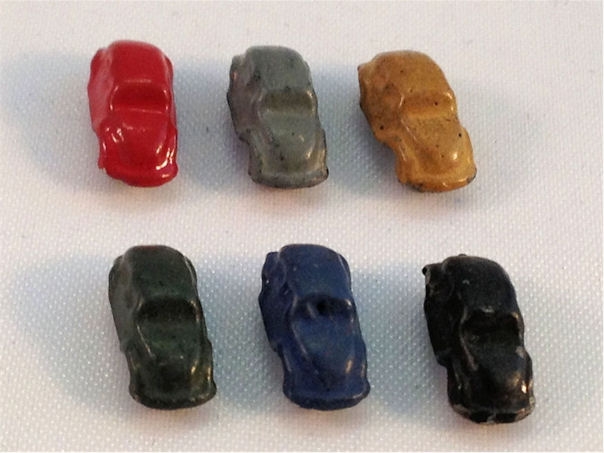
WIKING was founded by Friedrich Karl Peltzer in 1932. WIKING's beginnings were in producing ship models in 1:1,250 scale. Before and during World War II these models, made of lead based zamac, were used by the German military for training purposes. They were usually marked "WIKING MODELL" on their bases. Beginning in 1938, the planes and some of the ships were made of plastic. After World War II before starting production of model cars, WIKING experimented with a variety of miniatures such as Noah's ark, some clay models, and plastic combs and buttons. There was also a small series of the Berlin Airlift (1948/49) consisting of five planes and two car models in 1:400 scale. Volkswagen's Wolfsburg plant commissioned vehicles in a 1:40 scale around 1948. In the same time, WIKING started to produce simple car models that usually consisted of a single part - with no windows or chassis. These were made of plastic. Vehicle axles were made of wire with flat pinched ends, that when squeezed into the still warm vehicle body plastic, could not rotate. Thus the axles rolled with the wheels. Later models included a chassis. Peltzer died in 1981 at the age of 78. In 1984, WIKING was sold to the Sieper Lüdenscheid, known as SIKU model cars. WIKING had cooperation with the Danish PILOT Company in the late forties and the early fifties and they interchanged many molds.
A solid metal casting with the basic details of the Volkswagen. Was limited produced as a set to honor the Berlin Airlift in 1948. The Soviet forces cut off West Berlin for supplies over land and the Allies started supplying West Berlin through the air. Set included five airplanes, a truck and two miniature VWs.


