LESNEY Products & Co. Ltd. was founded in 1947 as an industrial die-casting company by founders Leslie Smith and Rodney Smith, who were unrelated. The company name was a melding of their first names. They soon were followed by designer Jack Odell. In 1949 the company started experimenting with toy making to take up surplus plant capacity during the Christmas season. Around this time, Jack Odell designed a small toy for his daughter. Her school only allowed children to bring toys that could fit inside a matchbox, so Odell crafted a scaled-down version of the LESNEY road roller. Based on the size restriction, the idea was born to sell the model in a replica matchbox — thus yielding the name of the series that would propel LESNEY to worldwide, mass-market success. The series would grow to, and then settle at a 72-vehicle line. One interesting detail was that the models were made to no particular scale, the object being to make them fit into a matchbox, thus a VW Bus could be the same size as a Greyhound bus!
In the early years of the series, LESNEY used a partner company, "Moko" (also named after its founder, Moses Kohnstam), to market and distribute its toys. The Moko trademark appeared on the boxes.
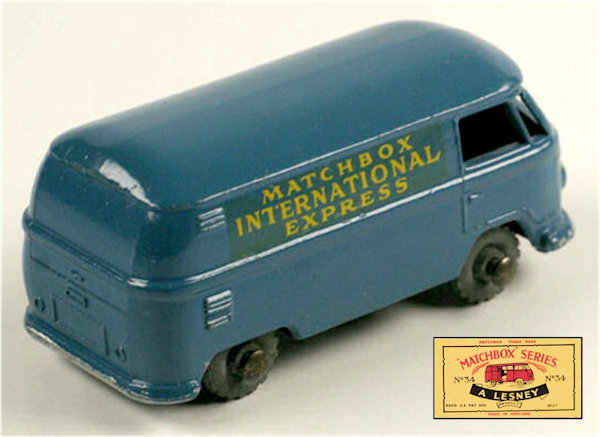
The MATCHBOX series of small diecast toys included the No. 34 Volkswagen Panel Van, first produced in 1957. It is known to collectors as the No. 34-A, to signify the first model in the series to be numbered 34. The Panel Van was painted blue and had cutout windows. Body details included door seams, side air louvers and engine lid. There was no rear window, and there were no side cargo door outlines. The headlights, front VW emblem and bumpers were painted silver. The black baseplate with metal wheels and axles was riveted to the body. A decal of MATCHBOX INTERNATIONAL EXPRESS was applied to the side of the Panel Bus.
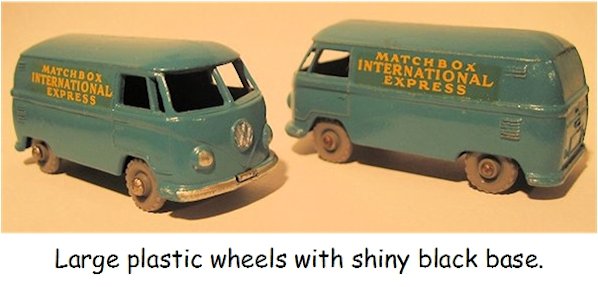
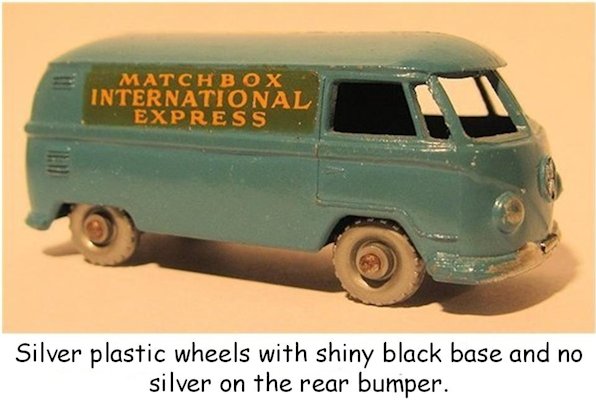
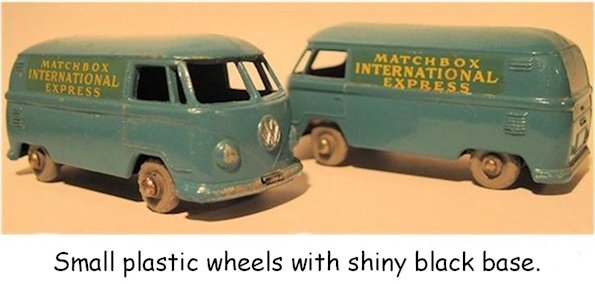
There were several variations, including crimped or rounded axles, diecast wheels (early production), gray plastic wheels in small and large sizes, and silver plastic wheels (late production), which are seldom seen. There were also a small number made with black plastic wheels, which are highly coveted by Matchbox collectors. The decals came in orange or yellow. These high-quality MATCHBOX models were extremely popular worldwide, and have formed the starting point for many toy collections.