A Zeppelin is a type of rigid airship pioneered by the German Count Ferdinand von Zeppelin in the early 1900s. It was based on designs he had outlined in 1874 and detailed in 1893. His plans were reviewed by committee in 1894 and patented in the United States on March 14, 1899. Given the outstanding success of the Zeppelin design, the term Zeppelin in casual use came to refer to all rigid airships.
Zeppelins were operated by the Deutsche Luftschiffahrts-AG (DELAG). DELAG, the first commercial airline, served scheduled flights before WWI. After the outbreak of war, the German military made extensive use of Zeppelins as bombers and scouts.
The WWI defeat of Germany in 1918 halted the airship business temporarily. But under the guidance of Hugo Eckener, the deceased Count's successor, civilian Zeppelins became popular in the 1920s. Their heyday was during the 1930s when the airships LZ 127 Graf Zeppelin and LZ 129 Hindenburg operated regular transatlantic flights from Germany to North America and Brazil. The Art Deco spire of the Empire State Building was originally designed to serve as a dirigible terminal for Zeppelins and other airships to dock. The Hindenburg disaster in 1937, along with political and economic issues, hastened the demise of the Zeppelin airships.
The term Zeppelin is a generalized trademark that originally referred to airships manufactured by the German Luftschiffbau Zeppelin GmbH, which pioneered dirigible design in the early years of the twentieth century. The word Luftschiff, German for "airship", usually prefixed their crafts' names.
In modern common usage, the terms Zeppelin, dirigible and airship are used interchangeably for any type of rigid (physical frame) airship, with the term blimp alone used to describe non-rigid (no physical frame) airships. Although the blimp also qualifies as a "dirigible", the term is seldom used with blimps. In modern technical usage, airship is the term used for all aircraft of this type, with Zeppelin referring only to aircraft of that manufacture, and blimp referring only to non-rigid airships.
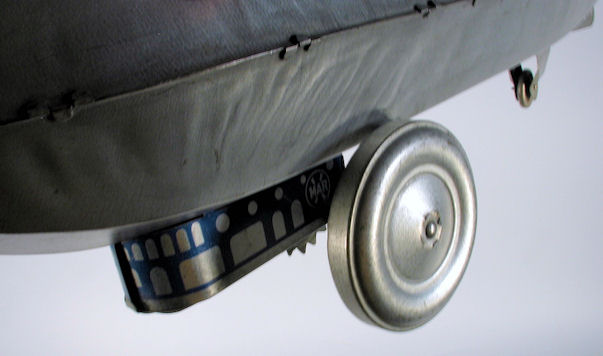
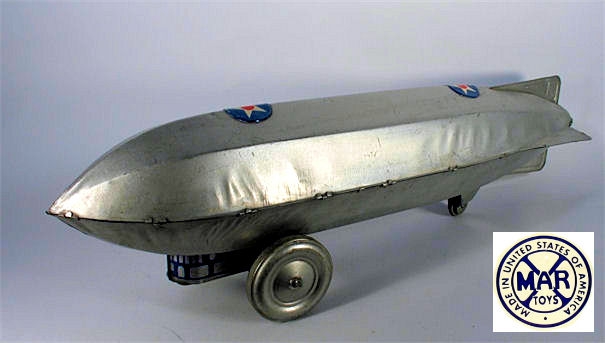
Louis Marx and Company was an American toy manufacturer in business from 1919 to 1972. Marx started his career working at Ferdinand Strauss Toy Company. At the age of 14, he purchased that Company in 1919 along with many toy dies. Ferdinand Strauss was a manufacturer of early mechanical toys. The MARX logo was the letters “MAR” in a circle with a large X through it, resembling a railroad crossing sign. As the X sometimes goes unseen, MARX Toys were, and are still today, often misidentified as “MAR” toys. Its products were often imprinted with the slogan, “One of the many MARX Toys, have you all of them?”
MARX’s Toys included tinplate buildings, tin toys, tin Zeppelins, toy soldiers, play sets, toy dinosaurs, mechanical toys, toy guns, action figures, dolls, dollhouses, diecast toy cars, and HO scale and O scale trains. MARX’s less-expensive toys were extremely common in dime stores. The larger, costlier toys were staples for catalog retailers such as Sears and Montgomery Ward, especially around Christmas time. In 1935, Louis Marx purchased the Girard Toy Company. In 1972 the MARX Toy Company was sold.
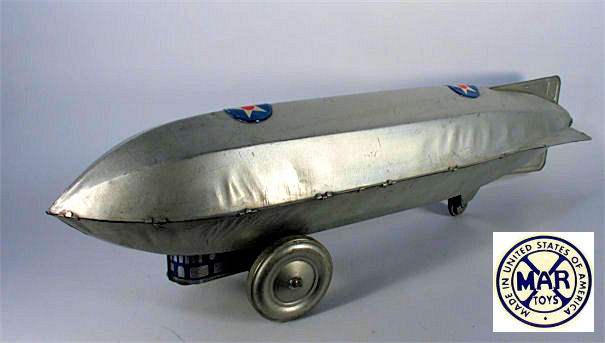
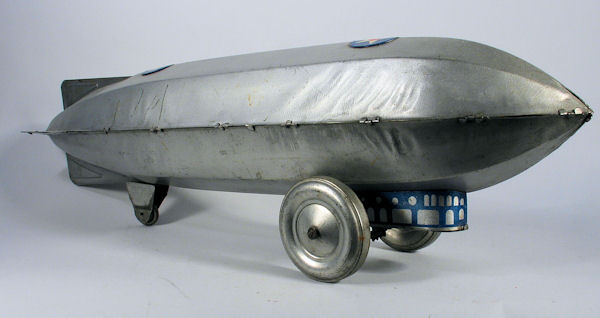
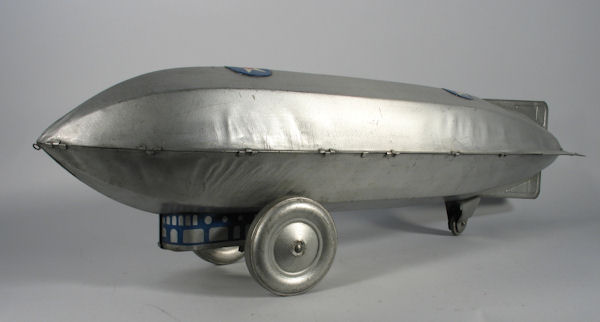
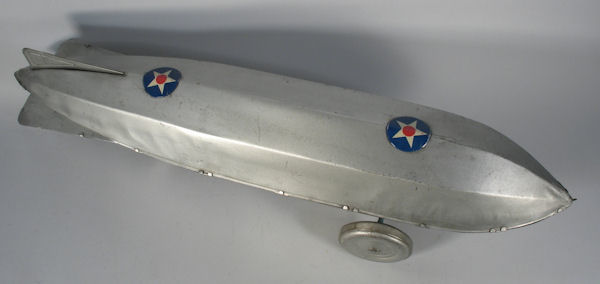
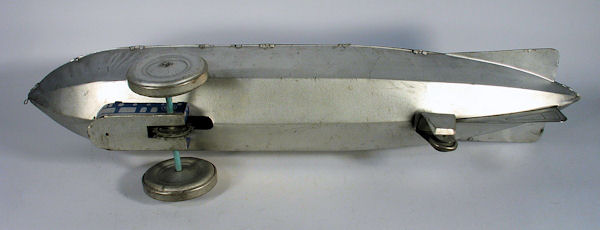
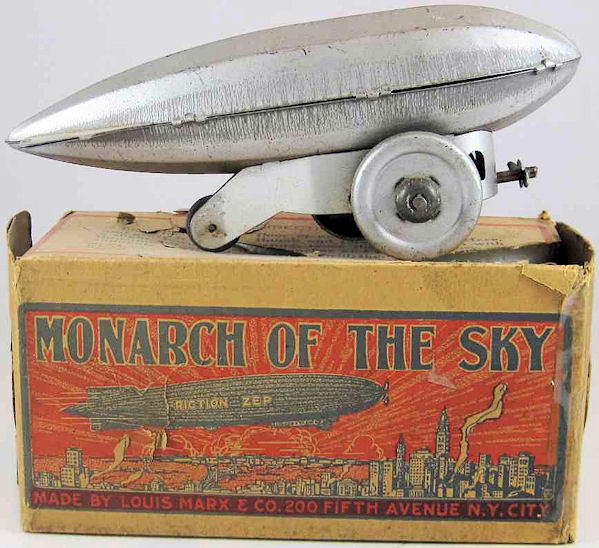
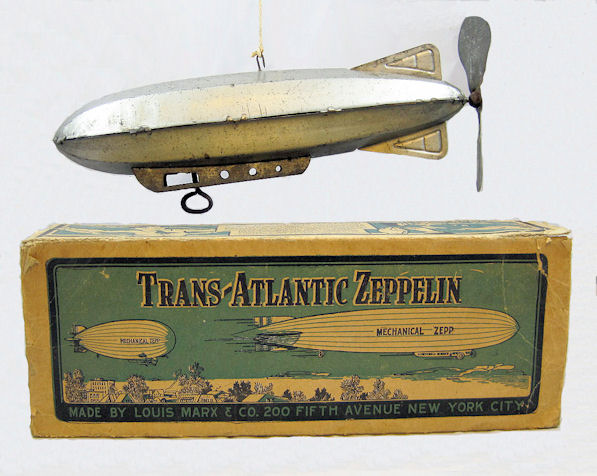
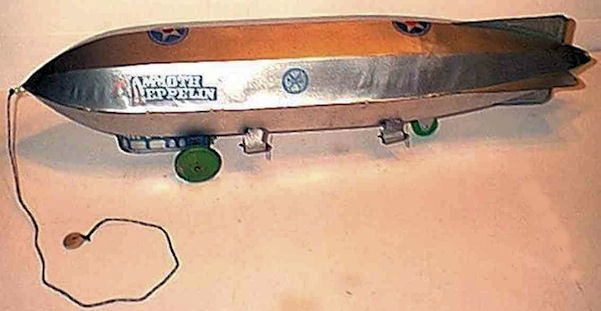
MARX Toys produced several toy Zeppelins in the 1930s. The smaller Zeppelins were the MONARCH ZEPPELIN (385mm long) and the TRANS-ATLANTIC ZEPPELIN (255mm long). The larger scale MARX Toys Zeppelin were made of 30 gauge steel sheets that were stamped out in two sections, upper and lower. The sections had long stamping lines that ran front to back. The two sections had many bent over tabs crimped together along the seam lines and formed the body and also the horizontal fins. A sheet metal gondola was attached to the lower section with bent over tabs locked into place with cutouts in the lower section. Inside the gondola area were several parts that included two pressed steel wheels and axle attached to the gondola. There was a spring steel strip that rubbed against a large gear on the axle to make a clicking sound when the Zeppelin was moving.
The vertical fins were made of sheet metal and were attached with bent over tabs from inside the body sections. There was a metal assembly that was made to accommodate a pressed steel wheel and axle. The wheel assembly was attached to the lower body section with rivets. The vertical fins are often broken off because they able to be bent back and forth easily. The horizontal fins are always in place because they were double thick steel formed from the upper and lower body sections crimped together.
The MARX Toy Zeppelin was about 27 inches (686mm) in length and was painted in a very nice silver color. There were also two large round discs that had decals of a five pointed red, blue and white star attached to the top of the upper section. There was a decal wrapped around the gondola to simulate windows and doors. There was another version of this Zeppelin that used a different decal set. The decal set theme was a red and blue MAMMOTH ZEPPELIN lettering on the sides of the upper section above the gondola. The MARX logo was on the sides of the upper section and on the gondola. This Zeppelin also had 4 engines with propellers attached to the lower section.