A Zeppelin is a type of rigid airship pioneered by the German Count Ferdinand von Zeppelin in the early 1900s. It was based on designs he had outlined in 1874 and detailed in 1893. His plans were reviewed by committee in 1894 and patented in the United States on March 14, 1899. Given the outstanding success of the Zeppelin design, the term Zeppelin in casual use came to refer to all rigid airships.
Zeppelins were operated by the Deutsche Luftschiffahrts-AG (DELAG). DELAG, the first commercial airline, served scheduled flights before WWI. After the outbreak of war, the German military made extensive use of Zeppelins as bombers and scouts.
The WWI defeat of Germany in 1918 halted the airship business temporarily. But under the guidance of Hugo Eckener, the deceased Count's successor, civilian Zeppelins became popular in the 1920s. Their heyday was during the 1930s when the airships LZ 127 Graf Zeppelin and LZ 129 Hindenburg operated regular transatlantic flights from Germany to North America and Brazil. The Art Deco spire of the Empire State Building was originally designed to serve as a dirigible terminal for Zeppelins and other airships to dock. The Hindenburg disaster in 1937, along with political and economic issues, hastened the demise of the Zeppelin airships.
The term Zeppelin is a generalized trademark that originally referred to airships manufactured by the German Luftschiffbau Zeppelin GmbH, which pioneered dirigible design in the early years of the twentieth century. The word Luftschiff, German for "airship", usually prefixed their crafts' names.
In modern common usage, the terms Zeppelin, dirigible and airship are used interchangeably for any type of rigid (physical frame) airship, with the term blimp alone used to describe non-rigid (no physical frame) airships. Although the blimp also qualifies as a "dirigible", the term is seldom used with blimps. In modern technical usage, airship is the term used for all aircraft of this type, with Zeppelin referring only to aircraft of that manufacture, and blimp referring only to non-rigid airships.
Founded in 1919, the Cleveland based MURRAY OHIO MANUFACTURING COMPANY got its start making parts for the growing automotive industry of the time. But soon after, MURRAY diversified, producing bicycles, steel toy cars, trucks, air planes, pedal cars, wagons and Zeppelin toys. This was a smart move that saved the Company once the American Depression hit in the 1930s. The bicycles produced carried the MURRAY name and the steel toys produced were sold under the STEELCRAFT TOY COMPANY name.
MURRAY has made many other products, including lawnmowers and tractors. It even made special order toy trucks that looked like a customer's full-size delivery trucks. MURRAY is still in business today.
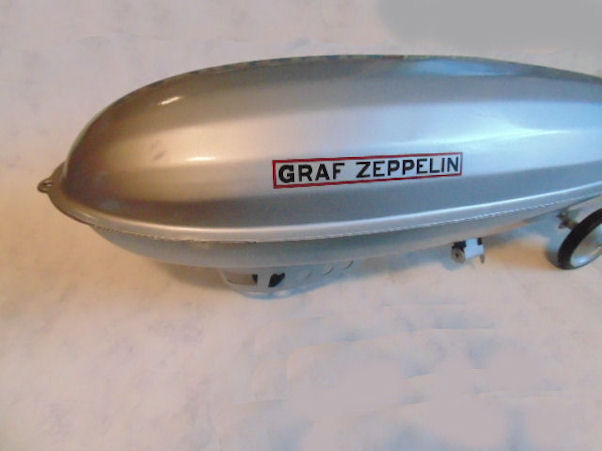
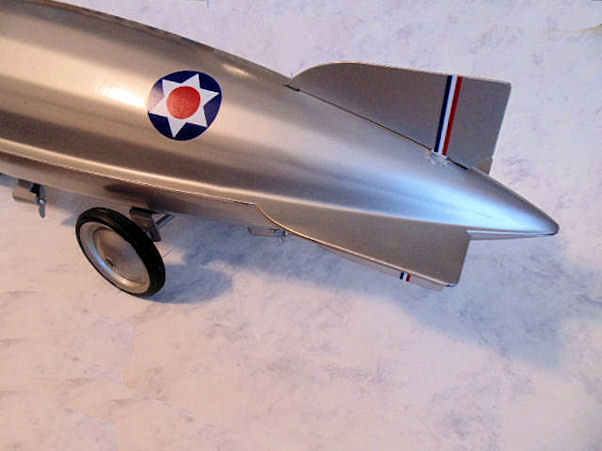
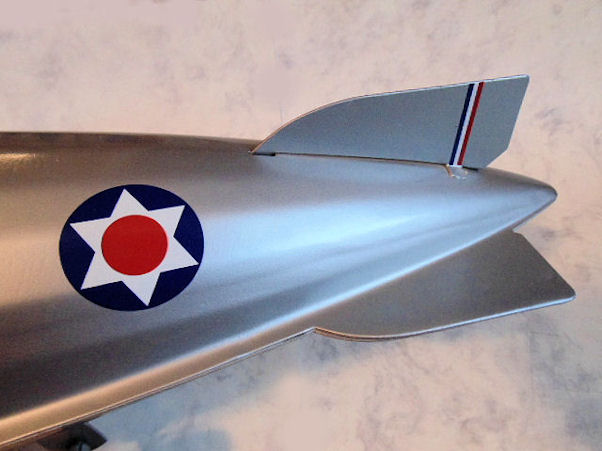
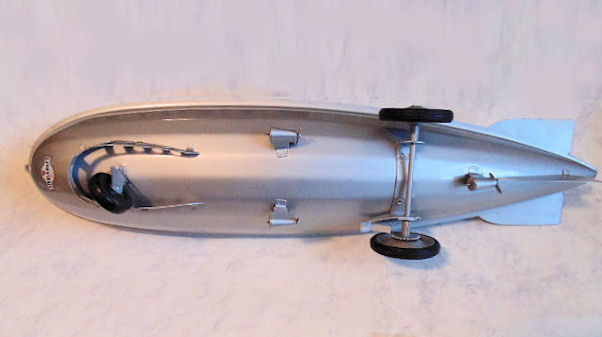
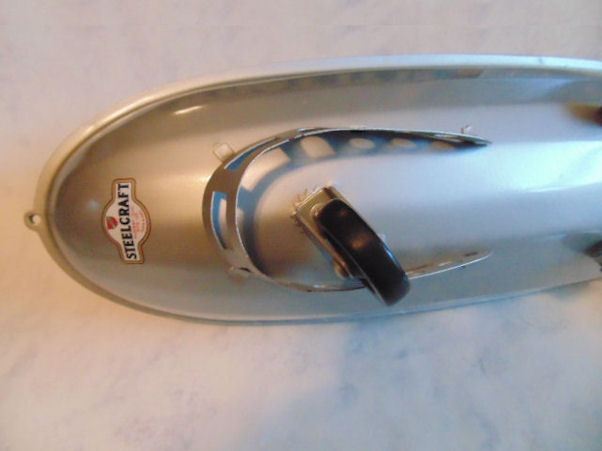
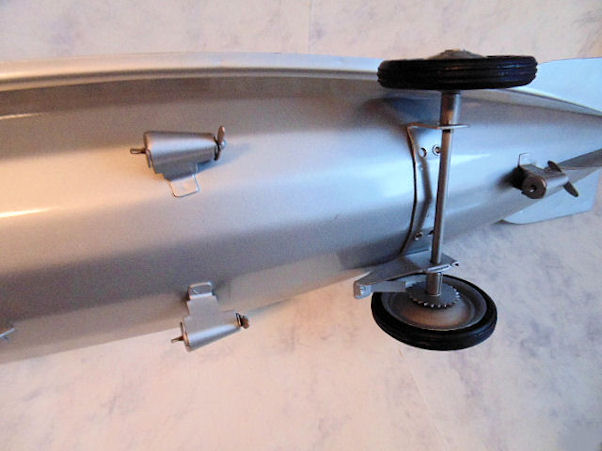
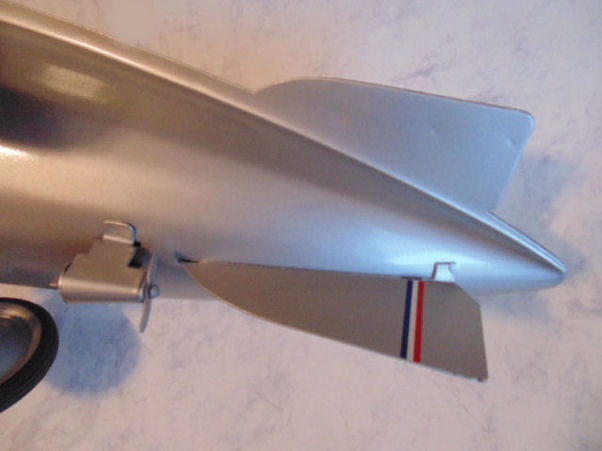
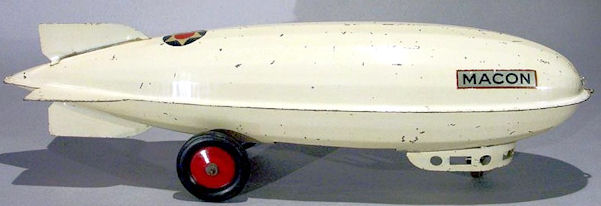
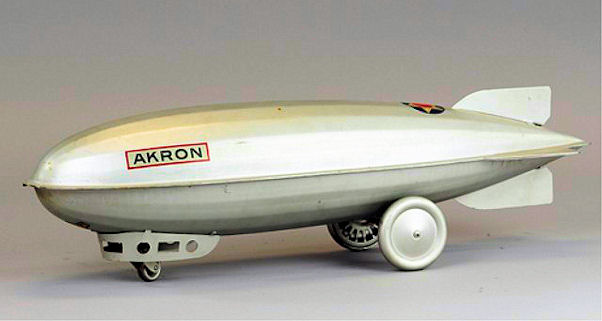
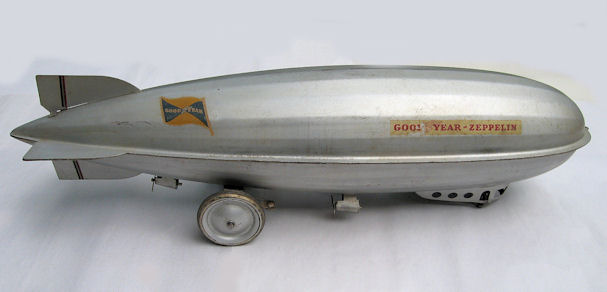
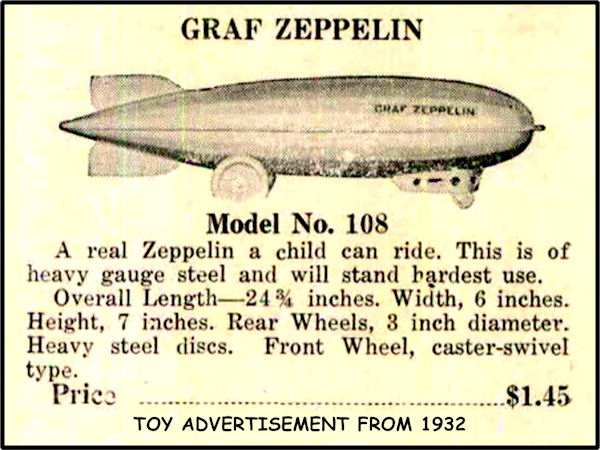
In the 1930s, STEELCRAFT produced a line of pull toy Zeppelins. The STEELCRAFT Zeppelins were made of heavy 18 gauge steel that were stamped out in two sections, upper and lower. The sections had long stamping lines that ran front to back. The two sections were spot welded together along the seam lines and formed the body and also the horizontal fins. A sheet metal gondola was attached to the lower section and spot welded into place. Inside the gondola area was a rectangular or round sheet metal part that was welded in place and provided the mounting platform for the front wheel that was a castor type wheel, metal or hard black rubber. A sheet metal brace was welded to the rear of the lower section that provided the support for the metal axle and wheels. There were several types of wheels used. A two section metal wheel stamped together was the most common used. Often found was a two piece metal rim welded together and a rubber tire installed on the rim. The last of the wheel type was just a solid black hard rubber tire that was sometimes painted in the center. The vertical fins were made of sheet metal and welded to the body. The vertical fins are often broken off because they were able to be bent back and forth easily. The horizontal fins are always in place because they were double thick steel formed from the upper and lower body sections welded together.
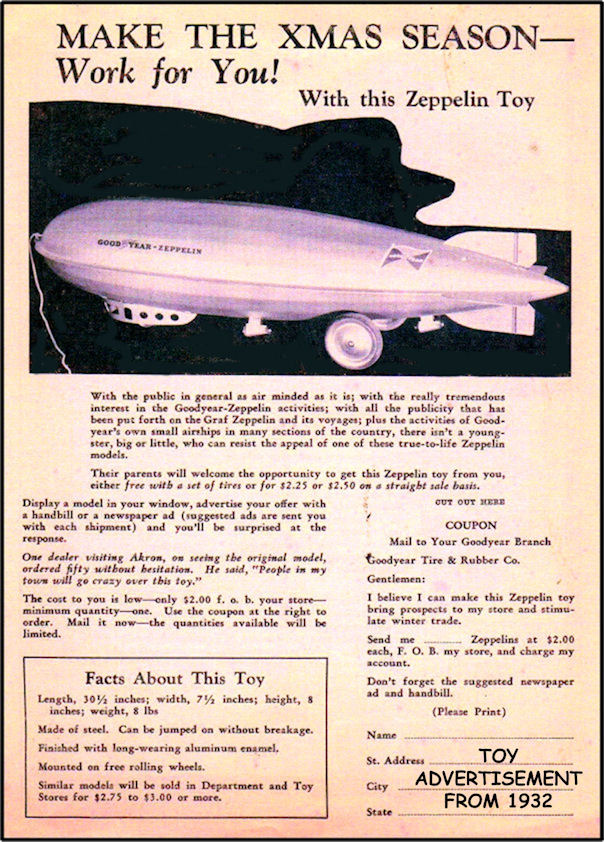
The STEELCRAFT ZEPPELIN was produced in two sizes. A 25 inch (635mm) and a 31 inch (787mm) version. The 31 inch version was huge, weighed 8 pounds (3628 grams) and featured three small steel engines, with spinning propellers, mounted under the lower section. Depending on the type of wheel used, some had a spring steel strip that was riveted to the rear wheel assembly that rubbed against the rear wheel to produce a clicking sound when the Zeppelin was in motion.
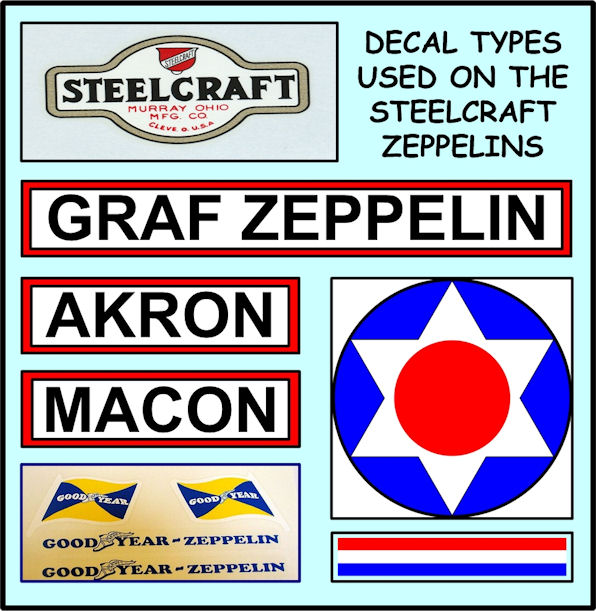
The STEELCRAFT Zeppelins were usually painted a very nice silver color and are sometimes found painted white. The wheels were usually found painted silver as well. STEELCRAFT manufactured the Zeppelins with four different decal sets, including GRAF ZEPPELIN, GOODYEAR-ZEPPELIN, AKRON and the MACON. These Zeppelins are found with those various names, circle stars, red/white/blue stripes on the vertical fins and the STEELCRAFT insignia in front of the gondola.
Along the seams in the front of the body section was a hole to attach a string for pulling the Zeppelin along the sidewalk or street. It was also advertised that the Zeppelin could be sat upon and pushed along as well. The original cost was around 2 dollars for these STEELCRAT Zeppelins toys. Because of their heavy steel construction, many have survived over the years but most are found in a rusty, dented condition and usually missing the vertical fins, wheels and gondola parts.